
Behind the Frame / Places / 040
A gesture against the sky
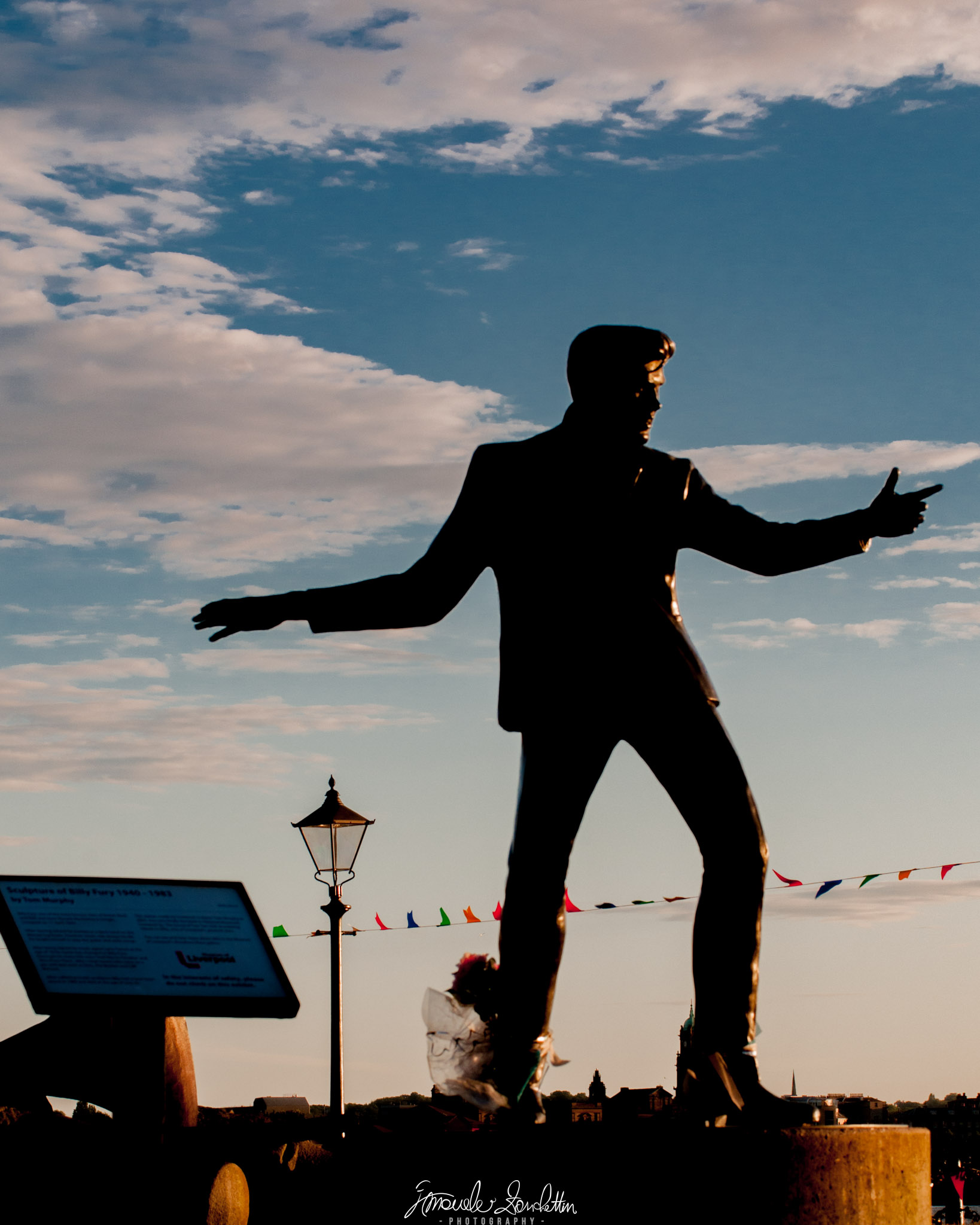
A silhouetted statue shows how much a pose can communicate before surface detail enters the picture.
01 / The message
The story
I see in it.
The extended arms are what I read first. With most of the statue reduced to darkness, its outline carries the expression of the photograph. The small bright edge on the face and clothing stops it from becoming an entirely flat cut-out.
Below, the lamp, bunting and sign return the figure to a public place. I like the contrast between that everyday collection of objects and the much larger gesture above them. Those small details give the large gesture a setting that feels lived in.
02 / Technique serving the idea
Reading the
technical choices.
The JPEG records 70mm, f/9, 1/320 sec and ISO 200. The dark body remains distinct because much of its outline falls against the lighter sky. Where its lower parts meet the foreground, the separation becomes less clear.
Lightroom Classic's clipping preview can identify areas rendered as pure black. [1] Here that would be information to consider, not an instruction to brighten every shadow: I would judge whether the silhouette still reads.
Keep & build on
A pose that survives simplification
The arms, separated legs and turned head make a recognisable gesture without requiring an evenly lit surface.
A small edge of light
Warm highlights pick out parts of the figure. I would keep that restrained sense of volume rather than make the whole statue equally visible.
Sky with enough character
The clouds give the background movement and variation while leaving clear blue space around much of the upper outline.
Question & explore
The sign in the corner
It helps describe the public setting, yet its large dark rectangle pulls my eye away. I would compare a viewpoint that changes its overlap with the figure.
The space around the hand
The right-hand gesture approaches the edge. A little more room might make it feel expansive; too much could reduce the statue’s visual presence.
Where shapes merge
The lower objects gather into a dense cluster. I would check whether a small change of camera position clarifies the feet without removing the useful context.
One practical next step
An experiment
to try.
Photograph a statue from two permitted positions while keeping the sky as its background. Review the outlines at thumbnail size. Ask which pose remains readable and which surrounding objects contribute something essential. The aim is clearer shape relationships, rather than automatically removing every detail.
Technical references
These sources support the marked technical explanations. The composition readings and experiments are my reflections.
Readers’ thoughts
Approved comments only · Shared across the English and Italian versions