
Behind the Frame / Nature up close / 034
A small bird and a big perch
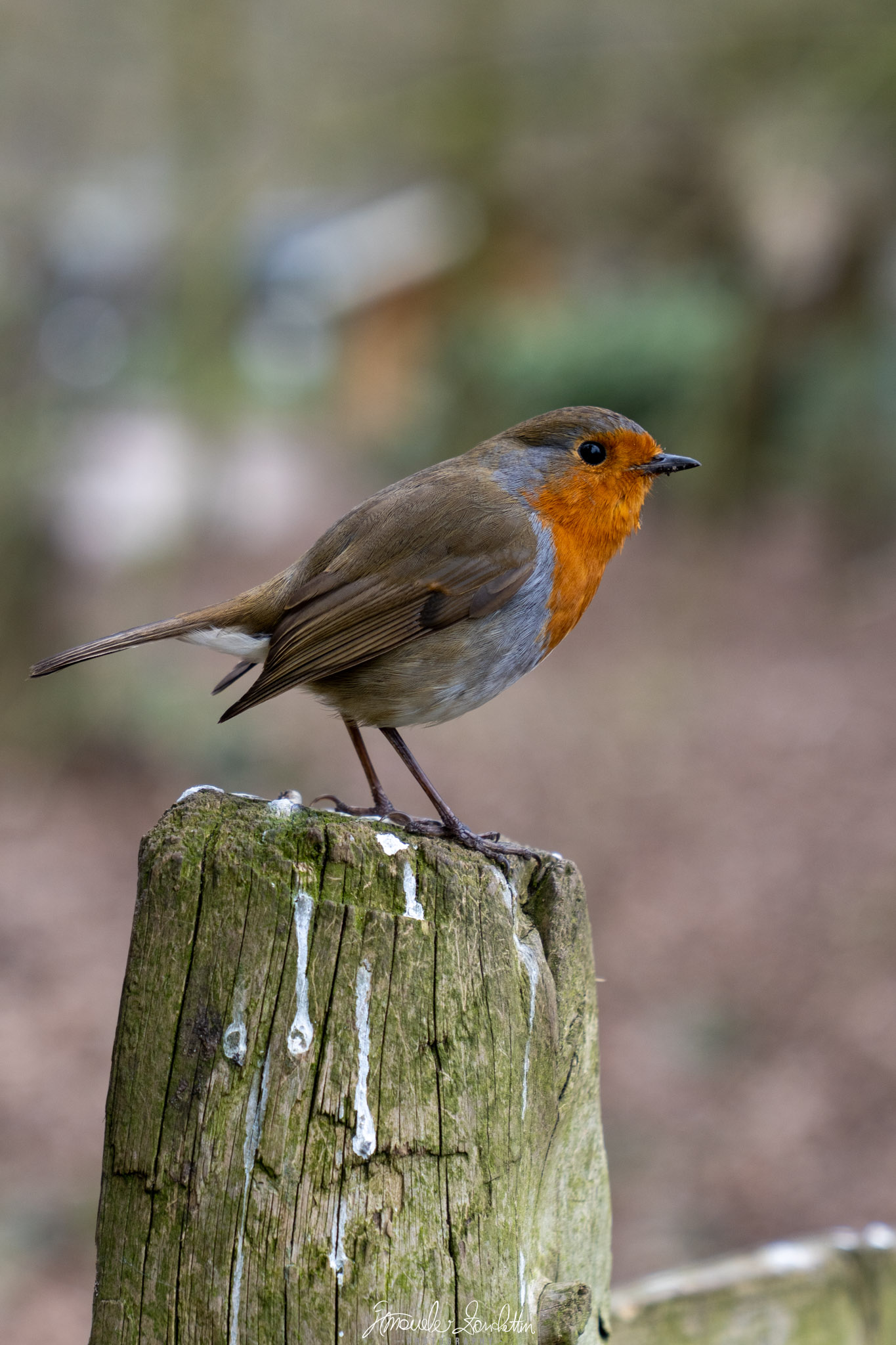
A robin's orange breast provides the spark, but the weathered post gives the picture much of its character.
01 / The message
The story
I see in it.
I find the eye, then follow the orange breast down to the thin legs and substantial perch. The post is large enough to become a subject of its own. Its cracks and pale marks make the bird feel part of an ordinary, used place rather than an isolated illustration.
That relationship interests me more than a perfectly empty background alone. The picture contains delicate feather detail and coarse timber in the same small space. I would like to preserve both, while ensuring that the bird continues to lead the conversation.
02 / Technique serving the idea
Reading the
technical choices.
The recorded settings are 70mm, f/3.5, 1/125 sec and ISO 200. The eye and much of the plumage are readable in this export. The soft background separates the outline, but a few pale patches still draw attention around the subject.
A faster shutter can reduce blur from movement. [1] For another frame, I would choose the shutter time for the bird's actual movement and check the result rather than copying 1/125 sec as a universal setting. A still-looking photograph does not tell me how long the subject remained in that position.
Keep & build on
A small but clear anchor
The dark eye is easy to locate within the orange face. It gives me a precise point of contact before I explore the rest of the frame.
Texture in conversation
Fine feathers sit above deeply split wood. Their different surfaces make the bird's scale and delicacy more apparent to me.
Space towards the gaze
The bird faces into open space on the right. That room keeps its direction readable without needing another subject there.
Question & explore
How much perch to keep
The post occupies a large lower area. I would compare a slightly tighter framing with this fuller version to see how much context earns its place.
Bright background patches
Pale circles sit behind the left side and near the lower edge. A small change in viewpoint might place them less insistently around the bird.
The tail at the side
The tail comes close to the left border. I would keep an eye on that spacing in another frame, even if the face remains my main focus.
One practical next step
An experiment
to try.
From an appropriate distance, observe a bird that is already using a perch without attracting or moving it. Make a wider frame and a tighter one when possible. Compare whether the perch adds a useful story or merely takes space; let the animal determine the opportunity.
Technical references
These sources support the marked technical explanations. The composition readings and experiments are my reflections.
Readers’ thoughts
Approved comments only · Shared across the English and Italian versions