
Behind the Frame / Nature up close / 016
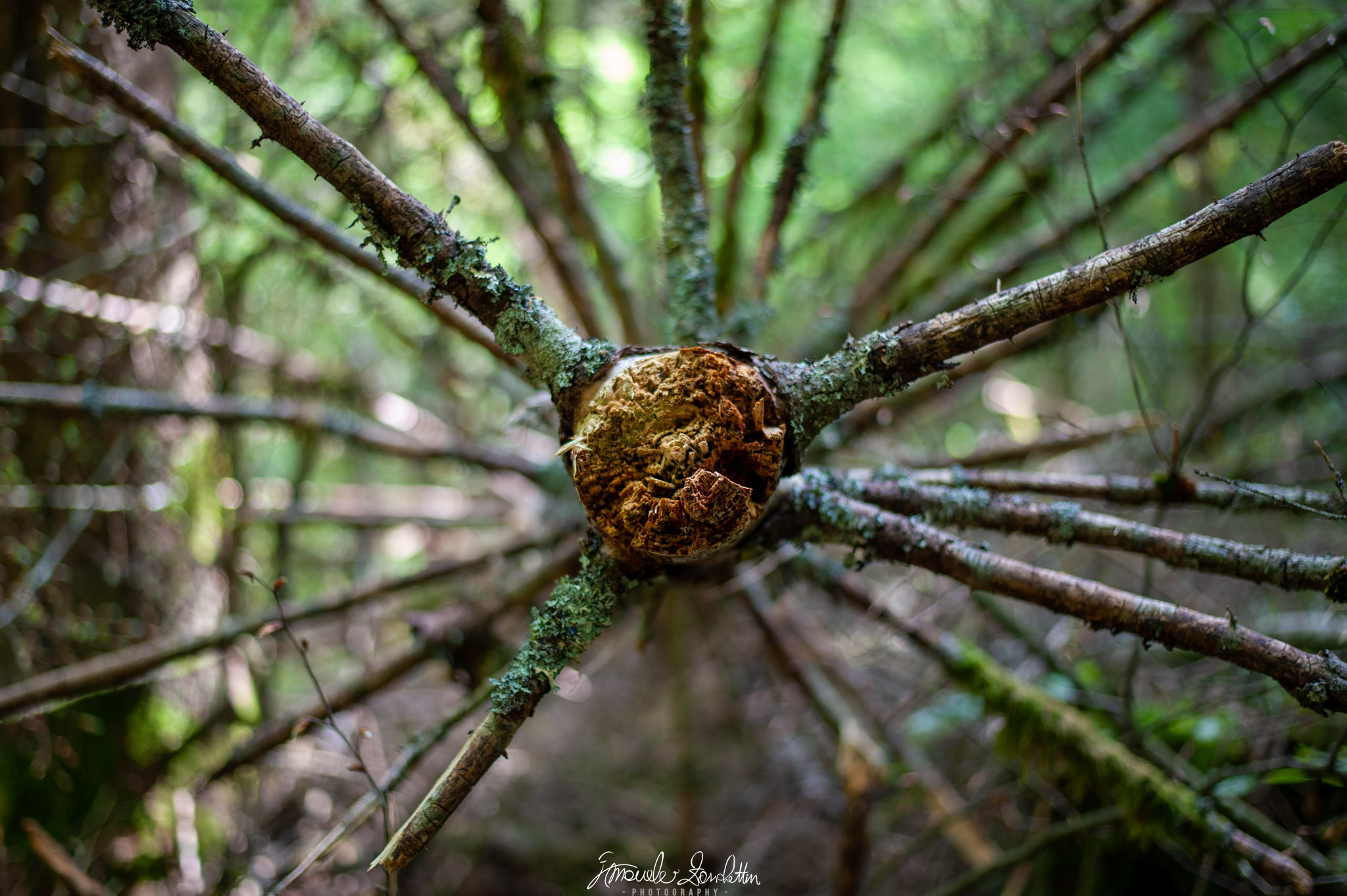
A wheel made of branches
Looking along a cut trunk turns familiar woodland material into a radiating pattern.
01 / The message
The story
I see in it.
I first see spokes, almost as if the woodland has produced a wheel. Then the bark and rough cut bring the object back into focus as wood. That brief move between pattern and recognition is what interests me most here.
The centre does not have to be perfectly smooth or symmetrical to hold the composition. Its irregular surface gives the pattern something to gather around. I read the picture as an invitation to look differently at ordinary material, rather than a description of an entire tree.
02 / Technique serving the idea
Reading the
technical choices.
The JPEG records a Nikon D700 at 50mm, f/1.8, 1/125 sec and ISO 100. Detail gathers around the wooden end, while branches and green surroundings become softer away from that area. I would check the original before judging the finest bark texture.
A smaller aperture would increase depth of field at the same focal length and focus distance. [1] That offers a useful comparison, though sharper distant branches could make this particular pattern less easy to read.
Keep & build on
A strong meeting point
The rough wooden end gives the radiating branches a destination. My eye repeatedly returns there after following a line outwards.
Imperfect repetition
The branches vary in thickness, angle and texture. That variety keeps the pattern from feeling mechanical or overly tidy.
Colour with restraint
Muted greens and warm wood feel closely related. They support the structure without dividing the photograph into competing colour blocks.
Question & explore
Bright background patches
Several pale gaps compete with the centre. A slight sideways shift could change their position while leaving the wood untouched.
Where the centre sits
The hub is nearly central. I would test a little more space on one side to see whether the spokes feel more energetic or simply less balanced.
Depth versus clarity
More branch detail might explain the object, while less might strengthen the abstract reading. Neither outcome is automatically an improvement.
One practical next step
An experiment
to try.
Find an existing natural pattern and photograph it from one fixed position at two apertures, adjusting exposure as needed. Focus on the same central detail. Compare which version makes the pattern readable and which better describes the material; leave the subject exactly as found.
Technical references
These sources support the marked technical explanations. The composition readings and experiments are my reflections.
Readers’ thoughts
Approved comments only · Shared across the English and Italian versions