
Behind the Frame / Places / 018
A wheel written in light
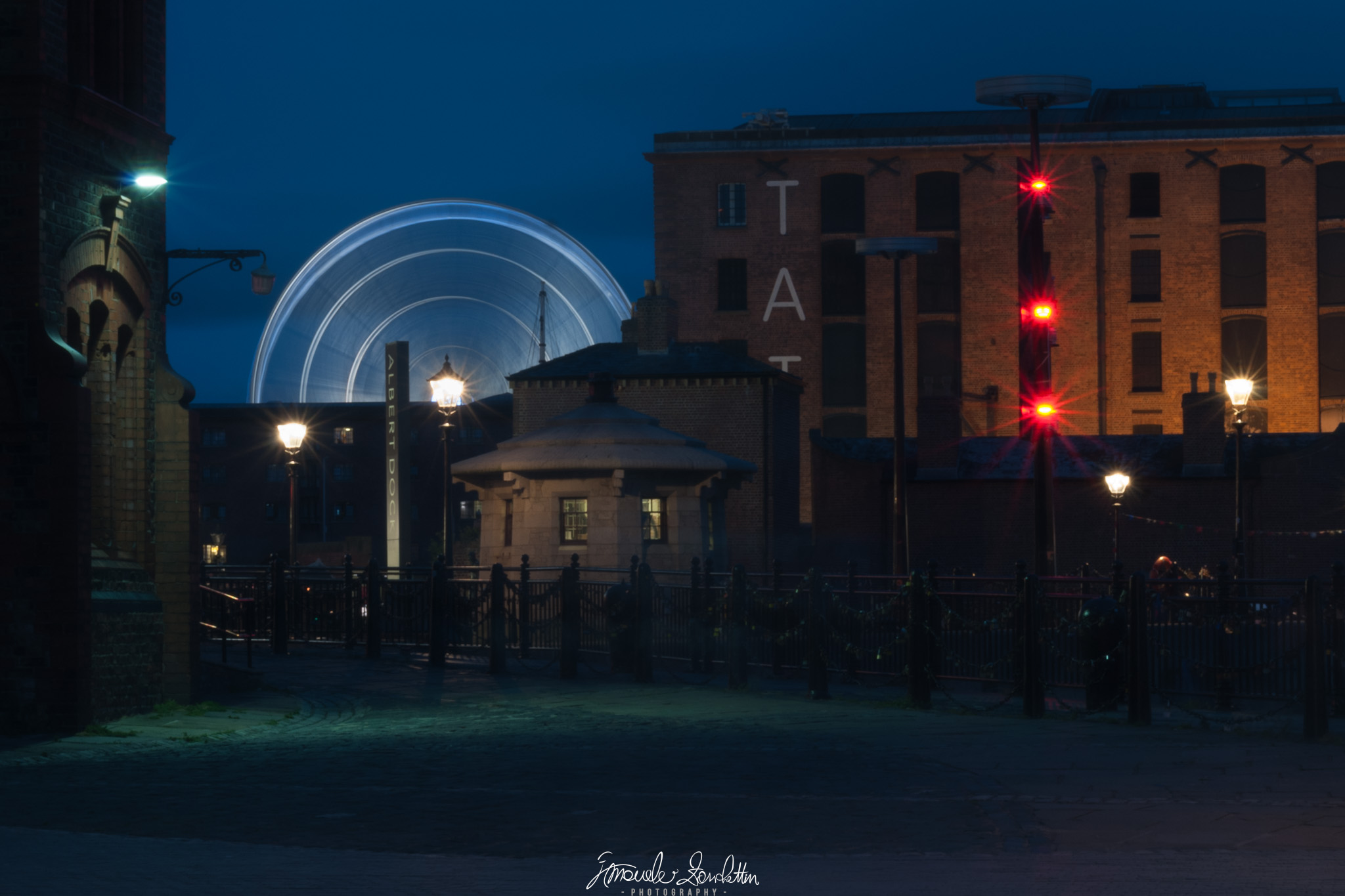
Pale arcs turn a night-time attraction into a drawing behind solid buildings.
01 / The message
The story
I see in it.
The wheel feels less like a structure than a set of lines drawn in the sky. In front of it, the buildings and railings remain solid, almost heavy. That difference gives the photograph two speeds: a place that holds still and a bright shape that keeps travelling.
I like how the wheel is partly hidden. The incomplete circle invites me to finish it mentally. At the same time, the red lights on the right offer a competing rhythm, so the photograph asks me to decide which kind of movement matters most.
02 / Technique serving the idea
Reading the
technical choices.
The JPEG records 50mm, f/22, 15 seconds and ISO 100. That long exposure is consistent with the visible light arcs. Moving lights can leave trails during a long exposure. [1]
The darker foreground supplies atmosphere, although much of its detail is difficult to read at a small size. I would review the image at its final display size before deciding whether those shadows should be opened or allowed to remain quiet.
Keep & build on
Two visual speeds
The curved traces and solid architecture make a clear contrast. I can sense movement without needing every mechanical detail of the wheel.
A convincing blue backdrop
The deep sky separates the pale arcs from the building silhouettes. It gives the light drawing enough room to be legible.
Overlapping layers
Railings, small structures and the larger building create depth. The wheel sits beyond them rather than floating without context.
Question & explore
The red-light competition
The three bright red points pull strongly to the right. I would compare a position where they play a smaller role if the wheel is the main subject.
The dark foreground
A little less empty paving in a future frame might strengthen the relationship between the arcs and buildings.
A shorter trace
A shorter exposure would be a useful alternative. I would compare whether less continuous lines describe the wheel more clearly or weaken the drawing.
One practical next step
An experiment
to try.
Choose a moving illuminated subject from a safe, fixed viewpoint. Compare several exposure times while keeping the framing stable and balancing brightness. Look for the point where motion becomes a readable shape rather than an indistinct glow; the longest exposure need not be your favourite.
Technical references
These sources support the marked technical explanations. The composition readings and experiments are my reflections.
Readers’ thoughts
Approved comments only · Shared across the English and Italian versions