
Behind the Frame / Landscapes / 001
An invitation to pause
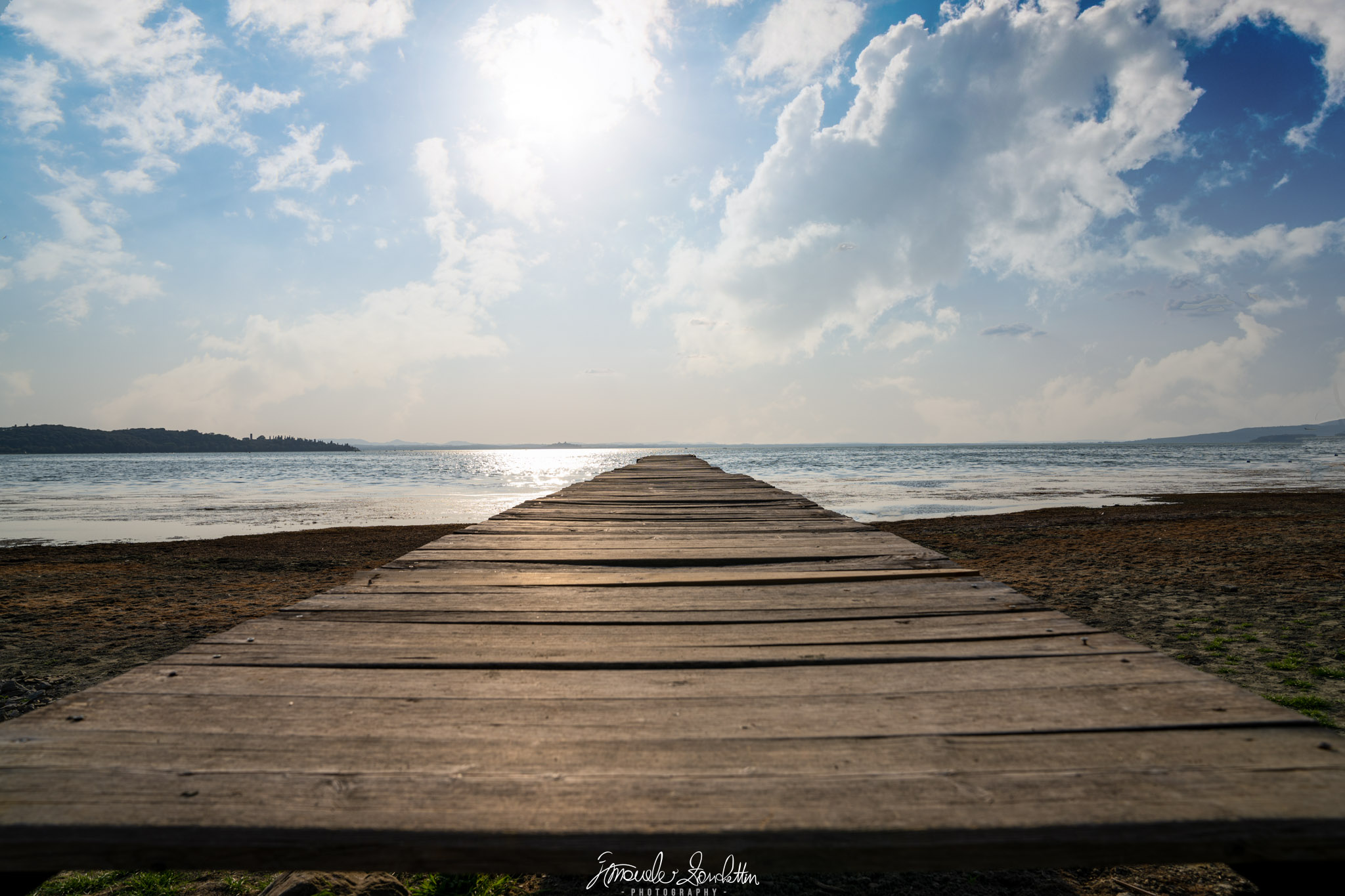
A wooden jetty takes us towards the water. What happens when the strongest part of a photograph is the space it leaves open?
01 / The message
The story
I see in it.
The jetty gives me somewhere to begin. Its boards feel close and tangible; beyond them, the water and sky open into something much less defined. My eye follows the path, reaches its end and keeps travelling. I read that as an invitation to pause, with no obvious destination and no person telling me what to feel.
There is another possible reading: an empty jetty can suggest absence as easily as peace. That ambiguity is interesting to me. The photograph leaves room for the viewer to bring something of their own.
02 / Technique serving the idea
Reading the
technical choices.
The recorded exposure is 24mm, f/5.6, 1/640 sec and ISO 50. In this JPEG, the closest boards look softer than those further along the jetty. I would check the full-resolution original before deciding whether that softness needs attention: this export cannot establish its cause or the exact focus point.
If more foreground detail supported the picture, f/8 would be a useful comparison. At the same focal length and focus distance, a smaller aperture increases depth of field, but does not guarantee that everything will look sharp. With unchanged light and ISO, maintaining the same exposure would require a longer shutter time. [1]
ISO 50 is an expanded setting on this camera, rather than the bottom of its standard ISO range. I would not present it as a general recommendation for the best image quality. [2]
Keep & build on
A clear route into the frame
The jetty’s converging edges carry my eye towards the horizon. Its near-central position gives the composition a stable, direct structure.
Texture against openness
The repeated boards give the foreground rhythm. The much quieter water beyond makes that change from solid ground to open space feel meaningful.
Room for the viewer
The empty jetty lets me imagine entering the scene. For this reading of the photograph, I would keep that emptiness.
Question & explore
Where the light takes my attention
My eye also jumps to the bright sun and reflection, left of the jetty. I would compare a gentler rendering of that area, checking Lightroom Classic’s histogram and highlight warnings in the original file. [3] This JPEG cannot tell me how much highlight detail the original holds. Too much darkening could lose the feeling of open daylight.
How much foreground the story needs
The nearest boards occupy a large part of the frame and look comparatively soft. At the scene, I would try a slightly higher viewpoint and compare how much foreground remains. I might gain a clearer view across the water, but lose some of the feeling of standing right at the jetty’s edge.
Whether sharper would feel better
I would compare the foreground at f/5.6 and f/8, checking focus as well as aperture. Extra detail would only be useful if it supported the journey into the frame; I would judge the whole photograph at its intended viewing size.
One practical next step
An experiment
to try.
Photograph a path, a jetty or a row of paving stones from two camera heights. Keep the focal length the same and make the exposures comparable. Before looking closely at sharpness, ask which frame better expresses your intended feeling. Then check the detail. Change one thing at a time and let the message guide the choice.
Technical references
These sources support the marked technical explanations. The composition readings and experiments are my reflections.
Readers’ thoughts
Approved comments only · Shared across the English and Italian versions