
Behind the Frame / Landscapes / 031
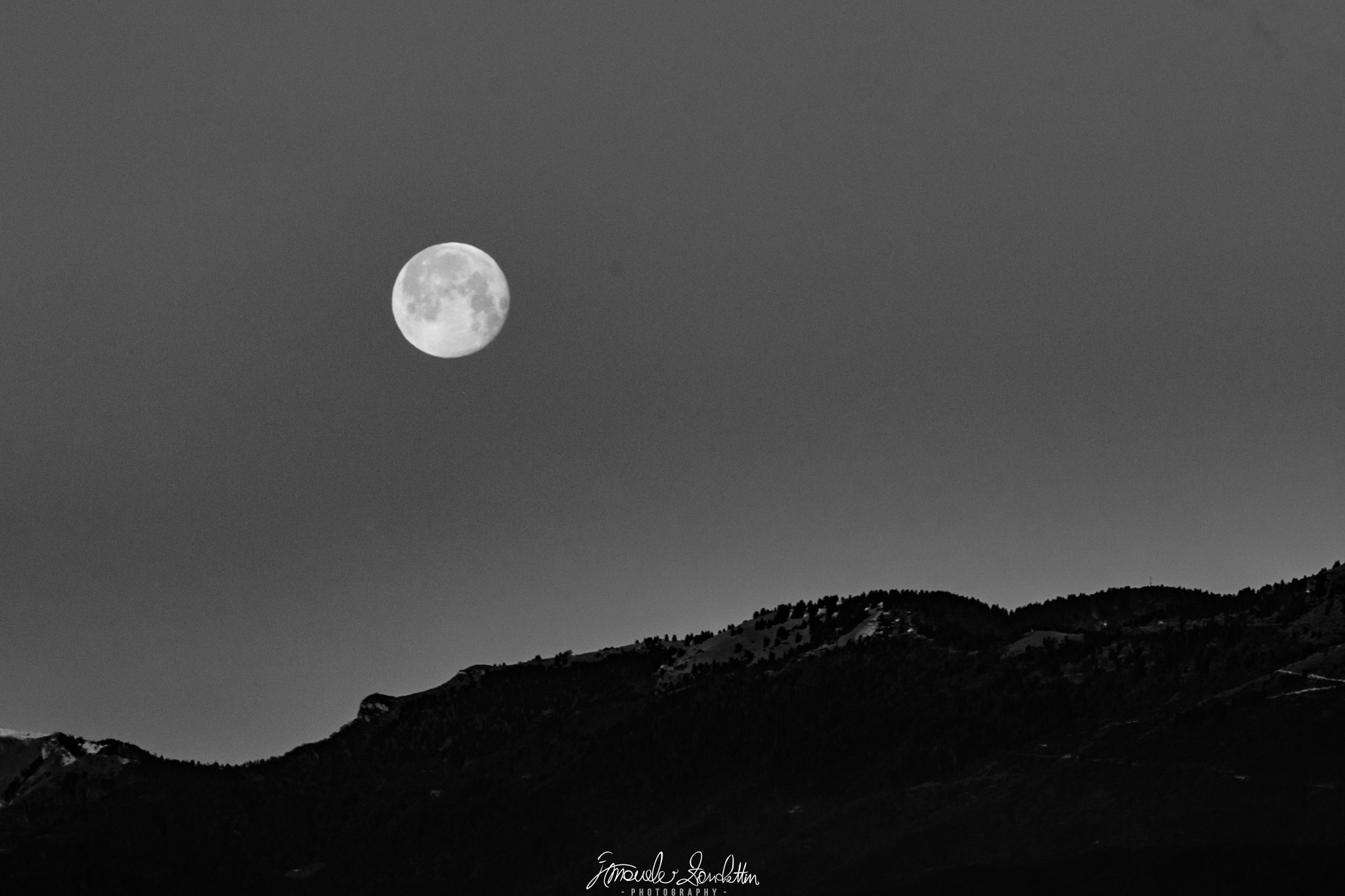
Moon above a dark ridge
A bright disc and an uneven ridge are enough to build a landscape. The work is in deciding how little else the picture needs.
01 / The message
The story
I see in it.
The moon looks small against all that sky, yet its brightness makes it impossible to miss. Below it, the ridge rises unevenly towards the right. I read a quiet conversation between a simple round shape and a much more irregular boundary.
The dark land gives the photograph weight. I do not need to see every tree for it to feel substantial. What interests me is the distance between the two forms: the clear gap allows the moon and ridge to remain distinct while belonging to the same composition.
02 / Technique serving the idea
Reading the
technical choices.
The JPEG records 200mm, f/9, 1/200 sec and ISO 100. Some tonal variation is visible within the moon, while the land is much darker. I would assess the moon's detail at the intended output size before deciding that a tighter crop or more sharpening would add anything useful.
Lightroom Classic's tone controls adjust bright and dark regions differently. [1] I would compare a modest lift of the ridge with the current dark treatment. More visible land is only an improvement if its details support the relationship with the moon; the silhouette-like weight may be the stronger choice.
Keep & build on
A clear hierarchy
The moon is the brightest compact form. It establishes a destination without needing to occupy a large part of the frame.
Two different outlines
The circular moon contrasts with the broken ridge and small tree shapes. That difference creates interest with very few elements.
Generous separation
The open sky between moon and land gives both shapes room. It lets the viewer move slowly between them rather than read one crowded cluster.
Question & explore
How much land to reveal
I would compare the present near-silhouette with a version showing slightly more ridge detail. The test is expressive weight, not maximum shadow visibility.
The amount of sky
There is a large quiet area above and around the moon. A tighter framing could feel more direct, but might also lose the sense of distance.
The left-hand ridge edge
The land enters the frame close to the bottom left. I would inspect whether a small change of framing gives that entrance a more deliberate shape.
One practical next step
An experiment
to try.
Use paper masks around a duplicate print or a reversible crop preview to compare three balances of sky and ridge. Keep the moon the same size at first. Describe how each frame changes the sense of distance before making any tonal adjustment.
Technical references
These sources support the marked technical explanations. The composition readings and experiments are my reflections.
Readers’ thoughts
Approved comments only · Shared across the English and Italian versions