
Behind the Frame / Still life / 027
The smallest point of balance
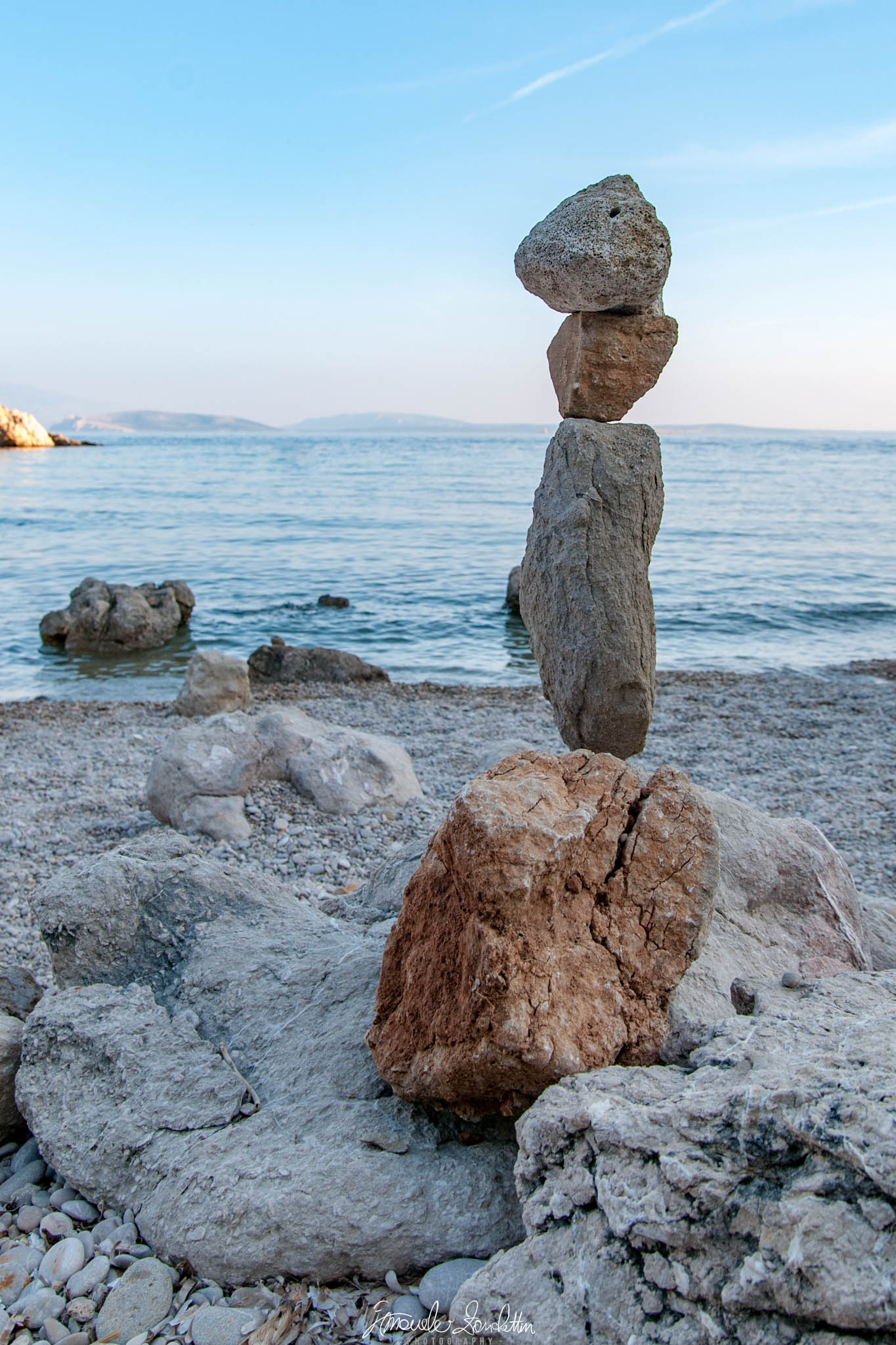
A narrow column of stones turns a shoreline into a study of weight, gaps and visual tension.
01 / The message
The story
I see in it.
My eye climbs from the broad brown base to the small contact points above it. The upper stones seem much less secure than the base, and that difference makes the photograph interesting to me. A still subject can contain a strong sense that something might change.
The sea gives the arrangement room, but the surrounding rocks also matter. They connect the stack to a larger field of similar material. I read a contrast between scattered shapes and one concentrated vertical line. That contrast gives the arrangement a clear role within the wider scene.
02 / Technique serving the idea
Reading the
technical choices.
The JPEG records 18mm, f/6.3, 1/160 sec and ISO 100. The stack occupies much of the picture's height, while the sea remains recognisable. I would judge the clear edges at each contact point before deciding whether more overall detail would help.
Stopping down increases depth of field when focal length and focus distance stay the same. [1] Here, extra background definition could make the scattered rocks more insistent. I would test that trade-off instead of assuming that the greatest possible depth of field is automatically the best choice.
Keep & build on
A readable vertical structure
Each stone has its own outline. The narrow contacts give the eye a sequence to follow from the ground upwards.
Texture with variation
The rough brown base differs from the cooler stones above. Those changes make the stack feel tactile without needing additional objects.
Space beside the subject
The open water to the left balances the tall form. The picture has a setting as well as a central arrangement.
Question & explore
The horizon intersection
The waterline passes behind the stack. I would compare a small change of camera height to see whether that intersection strengthens or interrupts the shape.
Foreground competition
Several pale rocks occupy the lower frame. A different position might simplify their overlaps while retaining the sense of a real shoreline.
The brightest edge
A sunlit rock at the far left attracts my eye. I would test a framing that gives it a clearer role or leaves it outside the picture.
One practical next step
An experiment
to try.
Practise with a safe arrangement of ordinary objects at home. Keep the objects fixed and make three pictures from slightly different heights. Compare the gaps and background intersections. The exercise is to improve the viewpoint, rather than make a more elaborate arrangement.
Technical references
These sources support the marked technical explanations. The composition readings and experiments are my reflections.
Readers’ thoughts
Approved comments only · Shared across the English and Italian versions