
Behind the Frame / Still life / 022
Water drawn into beads
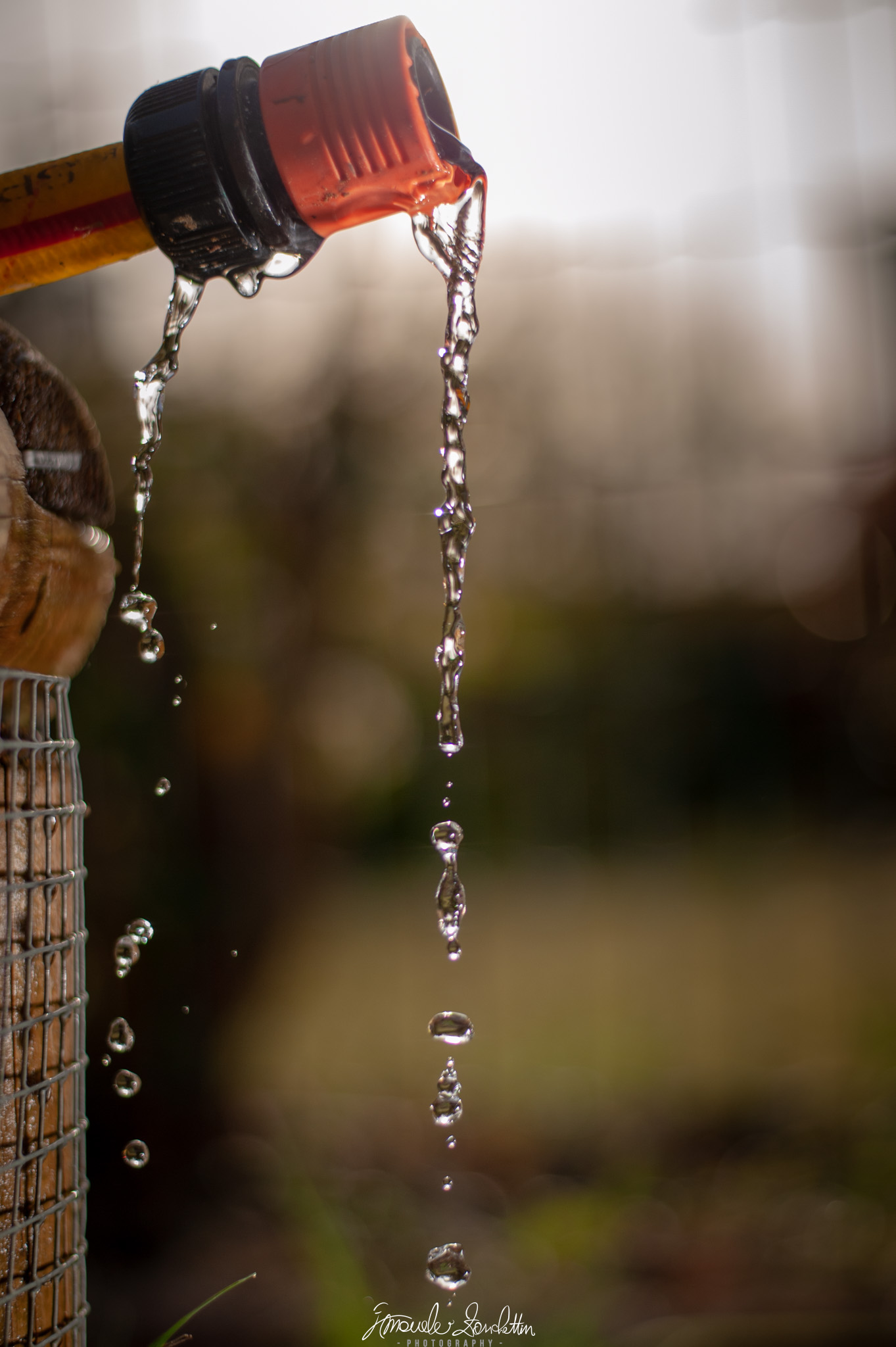
An ordinary hose fitting becomes interesting when flowing water separates into visible shapes.
01 / The message
The story
I see in it.
I follow the larger stream downwards until it breaks into individual beads. Each drop has a different outline, so something I normally experience as continuous becomes a sequence of small objects. The orange fitting gives that sequence a clear starting point.
For me, the subject is the act of noticing. The hose and post are ordinary, but the water offers a momentary pattern that would be easy to overlook. The challenge is keeping that discovery clear without letting the practical surroundings take over.
02 / Technique serving the idea
Reading the
technical choices.
The recorded settings are 50mm, f/1.8, 1/8000 sec and ISO 100 on a Nikon D700. Several drops have distinct contours, while the background is very soft. The larger droplets are clearer than several small ones on the left. I would compare their detail at the intended display size, rather than treating every softer drop as a problem.
Shutter time is one control over how movement is rendered. [1] I would compare exposures in a repeatable setup before crediting a single setting for the appearance of every drop. Here, the visible separation of the water matters more to my reading than a claim of perfect sharpness.
Keep & build on
A readable sequence
The continuous stream becomes separated droplets lower in the frame. That transition gives my eye a simple route to follow.
Light along the edges
Bright contours allow the water to stand out from darker areas behind it. The drops feel shaped rather than merely wet.
An everyday starting point
The orange fitting explains where the water comes from. It gives the abstract forms a practical, recognisable context.
Question & explore
The bright upper background
The large pale area behind the fitting competes with the water. I would try a viewpoint that places more drops against a quieter tone.
The left-hand structure
Post and wire mesh introduce a different pattern. A small framing change could preserve the source of the water while reducing that competition.
Room at the bottom
The final droplets approach the lower boundary. More space in a future frame might make the falling sequence feel less abruptly interrupted.
One practical next step
An experiment
to try.
Observe a small, controlled stream of water and compare a few shutter times with framing and focus held as consistently as possible. Balance exposure and avoid wasting water. Judge how the stream changes from line to separate shapes, then choose the version that best expresses your idea.
Technical references
These sources support the marked technical explanations. The composition readings and experiments are my reflections.
Readers’ thoughts
Approved comments only · Shared across the English and Italian versions