
Behind the Frame / Landscapes / 032
Finding order in the forest
A dense woodland offers more detail than the eye can take in at once. I am looking for a route through it, not a reason to remove its complexity.
01 / The message
The story
I see in it.
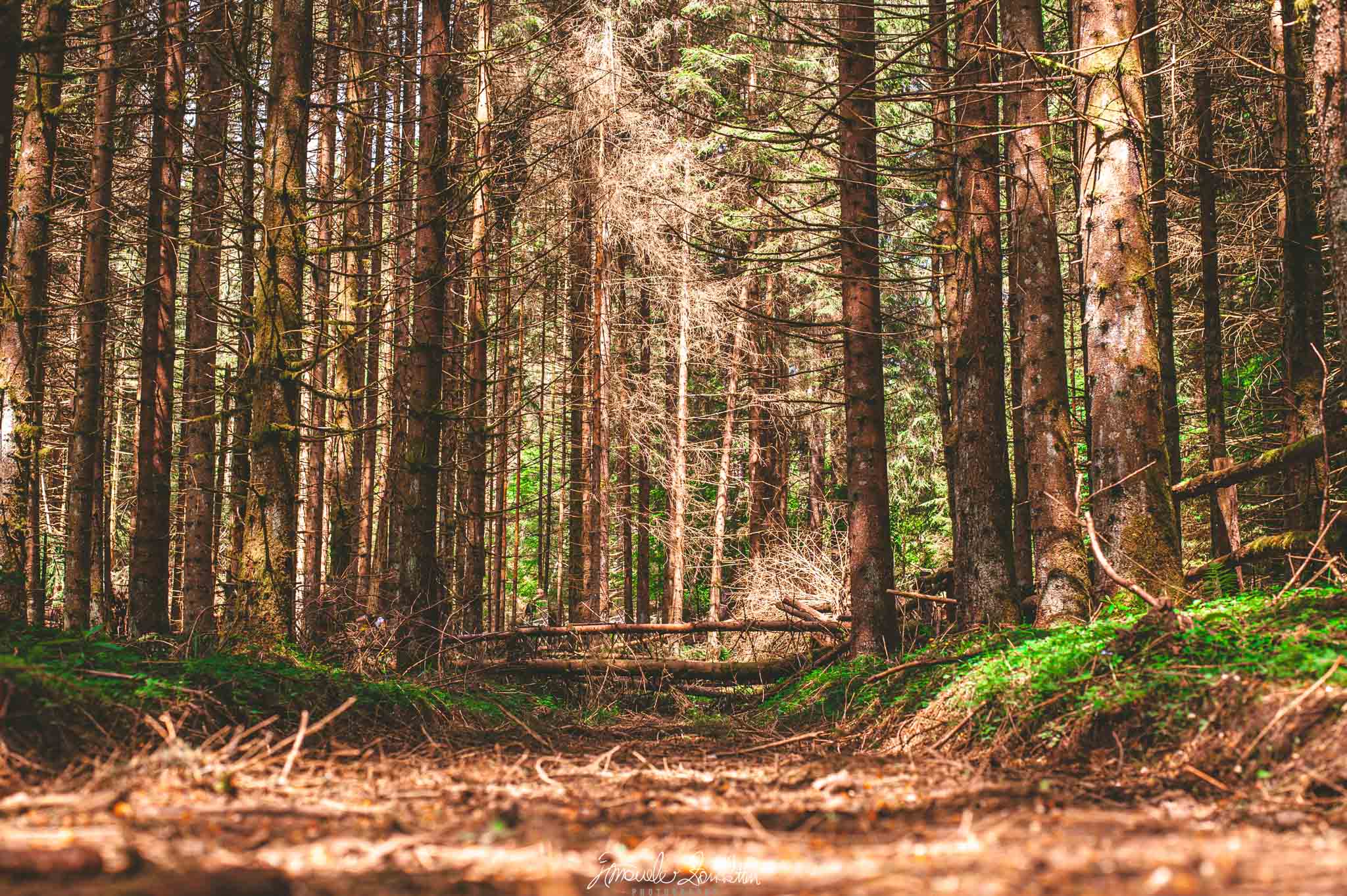
I begin near the ground, where the bright foreground opens towards the darker space between the trunks. The upright trees repeat like lines on a page, while branches cross them in every direction. The picture feels full, but there is a possible route through that density.
The fallen wood interrupts the route rather than completing a neat path. I like that complication. It keeps the woodland from becoming a simple corridor and reminds me that a photograph can invite the eye into a place without making every part easy to navigate.
02 / Technique serving the idea
Reading the
technical choices.
The recorded settings are 50mm, f/5, 1/100 sec and ISO 100. The closest ground is softer than the central trunks in this export. I would ask whether that softness helps me move into the picture before treating it as a problem that needs to be corrected.
Lightroom Classic masks allow local tonal changes. [1] I would test a quieter bright foreground while keeping the centre readable. This would be a small hierarchy adjustment: the woodland should still feel layered and irregular, rather than evenly lit from one edge to the other.
Keep & build on
Repeated verticals
The trunks give the busy scene a basic rhythm. Even where branches overlap, those larger lines hold the composition together.
A change in texture
The soft near ground gives way to finer detail further in. That difference helps me read depth rather than a flat wall of foliage.
Warm and cool patches
Warm bark and ground sit beside green vegetation. Their alternation gives the eye smaller discoveries within the repeated structure.
Question & explore
The bright foreground band
The lower edge is luminous and broad. I would compare how much of it is needed to open the picture without stopping attention before the trees.
A clearer central gap
Several branches overlap near the route into the frame. A small sideways move could change those intersections while preserving the woodland's density.
Choosing the main trunk
No single tree completely dominates. I would test whether one clearer anchor adds order or takes away the useful feeling of being surrounded.
One practical next step
An experiment
to try.
Stand at one safe woodland viewpoint and identify three possible routes for the eye. Make a frame for each using small position changes, without moving branches or fallen wood. Compare which version feels most inviting and which best communicates the density of the place.
Technical references
These sources support the marked technical explanations. The composition readings and experiments are my reflections.
Readers’ thoughts
Approved comments only · Shared across the English and Italian versions