
Behind the Frame / Places / 019
Passing through the arches
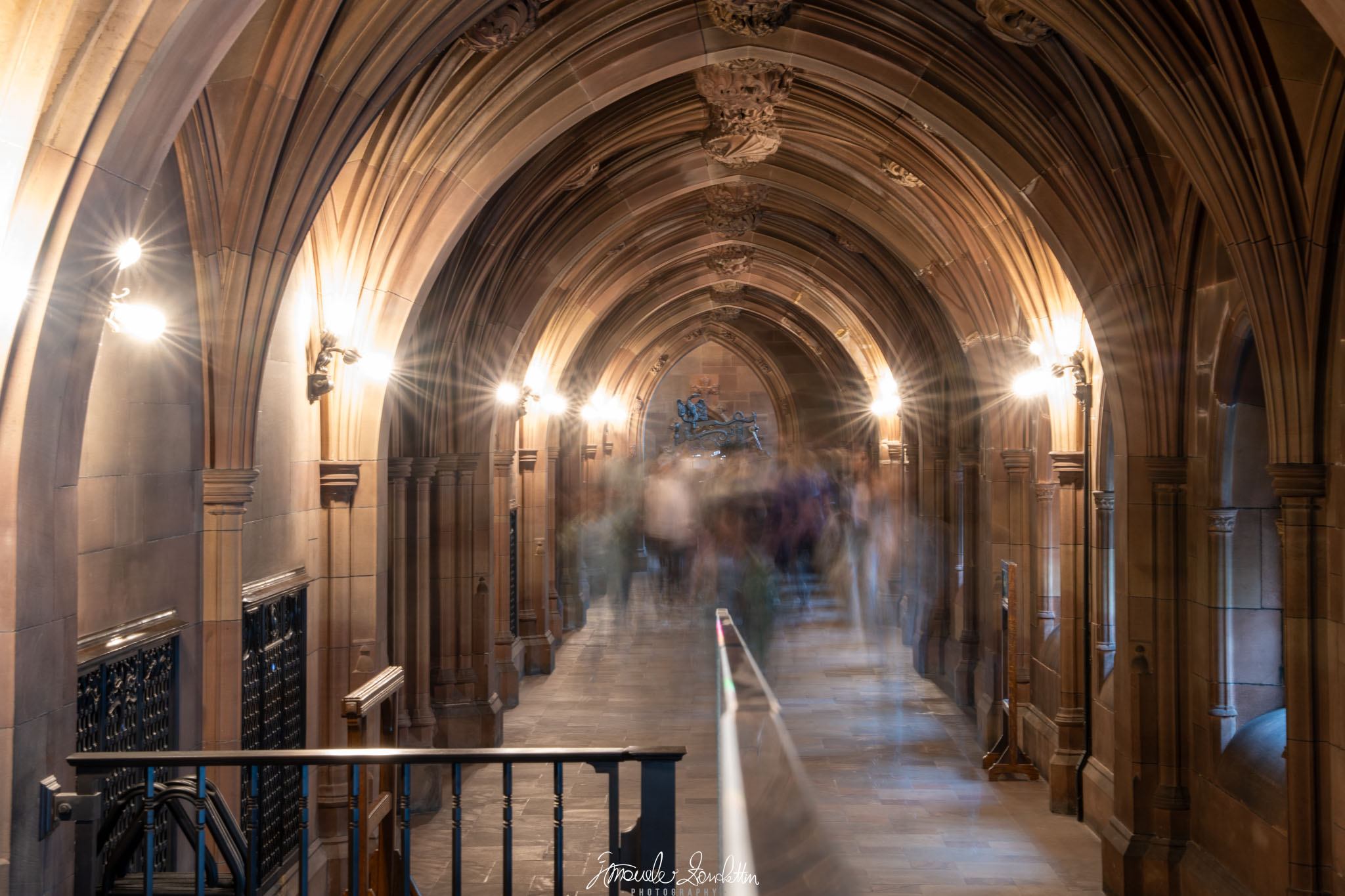
A vaulted corridor holds its shape while the people within it become traces of a visit.
01 / The message
The story
I see in it.
The arches give this photograph a lasting structure, while the people seem temporary within it. Their blurred forms become a reminder of passing through rather than individual portraits. I find that relationship between a place and its visitors more interesting than an empty architectural view.
The central barrier carries my eye towards the group, but also divides my route into the scene. It is an ordinary practical object with a strong visual role. The picture makes me consider how much of that everyday use I want an architectural photograph to retain.
02 / Technique serving the idea
Reading the
technical choices.
The supplied file records 70mm, f/18, 15 seconds and ISO 200. Moving people can blur during a long exposure while stationary features remain more defined if the camera is kept steady. [1] The JPEG does not establish what support was used here.
The lamps are very bright and produce conspicuous rays in the image. I would assess their visual weight before deciding to alter anything: they articulate the corridor’s rhythm, but sometimes hold my attention longer than the stonework or people.
Keep & build on
Repeated arches
The successive curves draw me into the passage. Their rhythm remains clear even though the middle of the frame is busy.
Movement with context
The people are softened enough to suggest passage while still reading as visitors. They give the architecture a human scale.
Warm continuity
Related warm tones run along the stone and lights. The corridor feels like a connected space rather than separate bright patches.
Question & explore
Lamp dominance
I would compare a rendition with quieter bright areas and check whether the eye follows the arches more easily.
The foreground railing
The dark horizontal rail interrupts the route into the frame. A different permitted viewpoint could give it a less dominant position.
How much blur?
An alternative, shorter exposure might separate a few figures more clearly. That could strengthen the human story or make the scene feel busier.
One practical next step
An experiment
to try.
In a place where photography is allowed, compare a quick exposure with a longer one from a stable position that does not obstruct visitors. Keep the architectural framing similar. Decide whether recognisable gestures or anonymous movement better express your relationship with the space.
Technical references
These sources support the marked technical explanations. The composition readings and experiments are my reflections.
Readers’ thoughts
Approved comments only · Shared across the English and Italian versions