
Behind the Frame / Still life / 020
Rhythm in a perforated surface
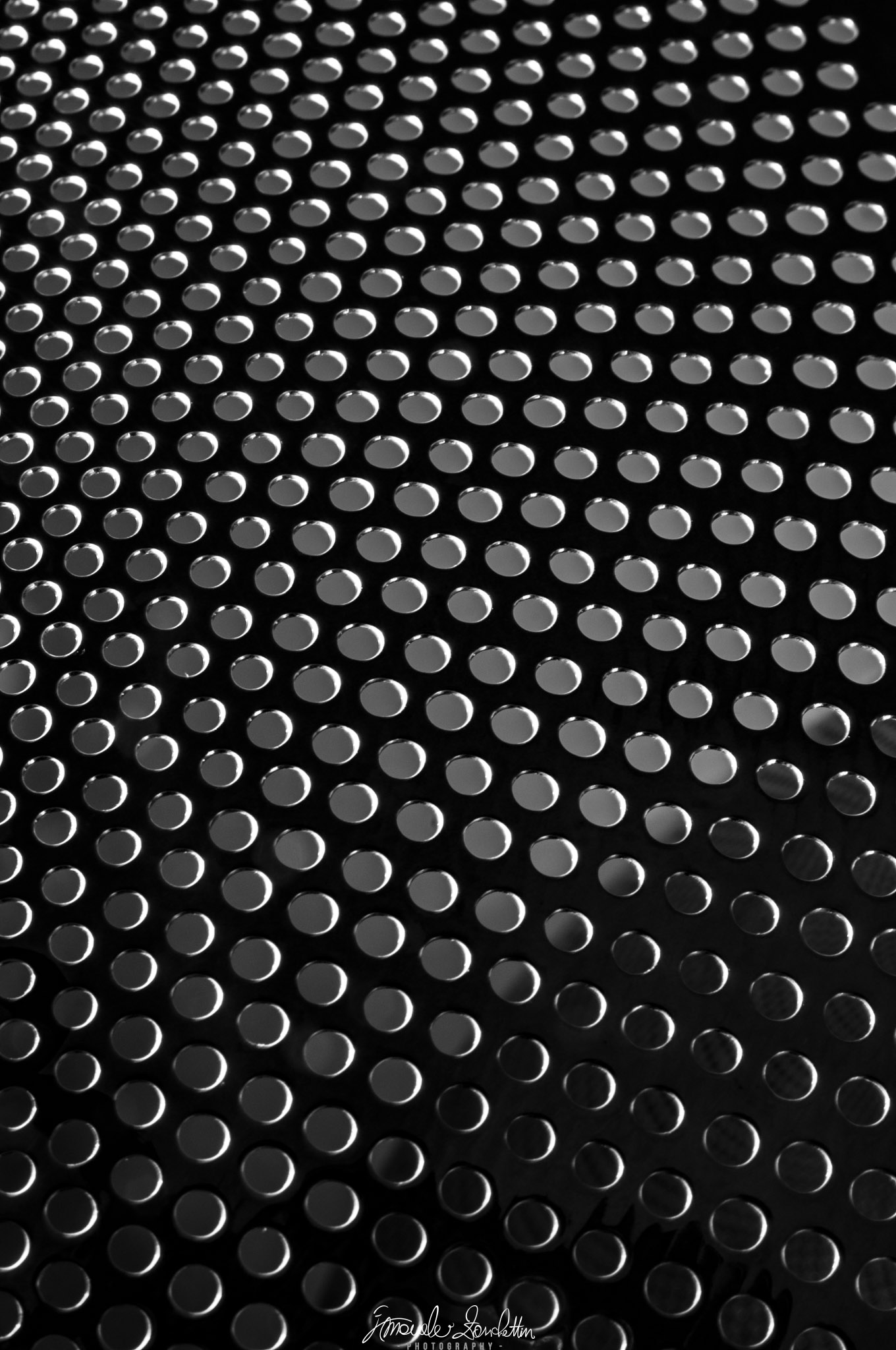
A field of circles becomes an abstract photograph through repetition, tone and a gradual change of scale.
01 / The message
The story
I see in it.
At first this feels like a pattern with no obvious beginning or end. The rows continue beyond the borders, inviting me to imagine a much larger surface. Then I notice that the circles are not all equally bright or equally defined, and the repetition begins to feel less uniform.
I enjoy that movement between order and variation. The photograph does not need to tell me what the object is for. It asks whether an ordinary surface can hold my attention through the way light describes its repeated shapes.
02 / Technique serving the idea
Reading the
technical choices.
The recorded settings are 50mm, f/18, 10 seconds and ISO 100. The supplied JPEG is monochrome. Bright rims sit against deep blacks, with some softer circles towards the edges; the export alone does not tell me the cause of every variation.
Lightroom Classic’s clipping preview can identify tonal values reaching the ends of the range. [1] I would use it to inspect these bright rims and dark gaps, then decide which lost detail matters to this abstract reading rather than treating every warning as a fault.
Keep & build on
Repetition beyond the frame
The cropped rows suggest continuation. This makes the photograph feel like a selected passage from a larger visual rhythm.
A limited vocabulary
Circles, dark gaps and bright rims are enough to sustain the image. There is little competing subject matter to explain.
Small differences
Changes in brightness and definition stop the pattern becoming completely flat. My eye searches for exceptions within the repeated shapes.
Question & explore
Edge decisions
Some circles are cut by very narrow margins. In a future frame I would check whether those fragments feel intentional or visually awkward.
A place for the eye to rest
The pattern is dense throughout. I would compare a composition including one larger quiet area, if the subject offers it.
Strength of contrast
A gentler tonal version might reveal more of the surface, while the current deep blacks favour abstraction. I would compare both at the same size.
One practical next step
An experiment
to try.
Find a repeated pattern in an everyday object. Make one frame that describes the object and another that fills the view with repetition. Compare their edges carefully. Decide whether mystery or recognition makes the stronger photograph, without assuming abstraction requires the highest possible contrast.
Technical references
These sources support the marked technical explanations. The composition readings and experiments are my reflections.
Readers’ thoughts
Approved comments only · Shared across the English and Italian versions