
Creative techniques
Creative shutter experiments: freeze, blur and zoom
Photography is physics made visible. The shutter does more than control brightness: it decides how much change can become part of one frame. These three experiments use that idea to create the effect while taking the photograph, then use repetition to make the result better.
The short version
- A photograph records what light and movement do over a period of time.
- Flash can freeze a brief event; a slow shutter can make movement visible.
- Change one variable at a time so an unsuccessful frame still teaches you something.
Treat time as a photographic material
While the shutter is open, the sensor continues to collect light. A stationary edge keeps landing in the same place and looks defined. A moving subject reaches different places during the exposure and can become a trail, a transparent shape or a complete blur. If most of the useful light arrives in one very short flash, that pulse can record just one instant of a much longer event.
That is the physics behind these photographs. Basic editing may refine brightness, contrast or colour afterwards, but the splash, the moving figures and the radiating lines were decisions made during the exposure. The camera is not only recording a subject; it is recording what happened to the subject and the light over time.
Freeze an instant with a short pulse of light
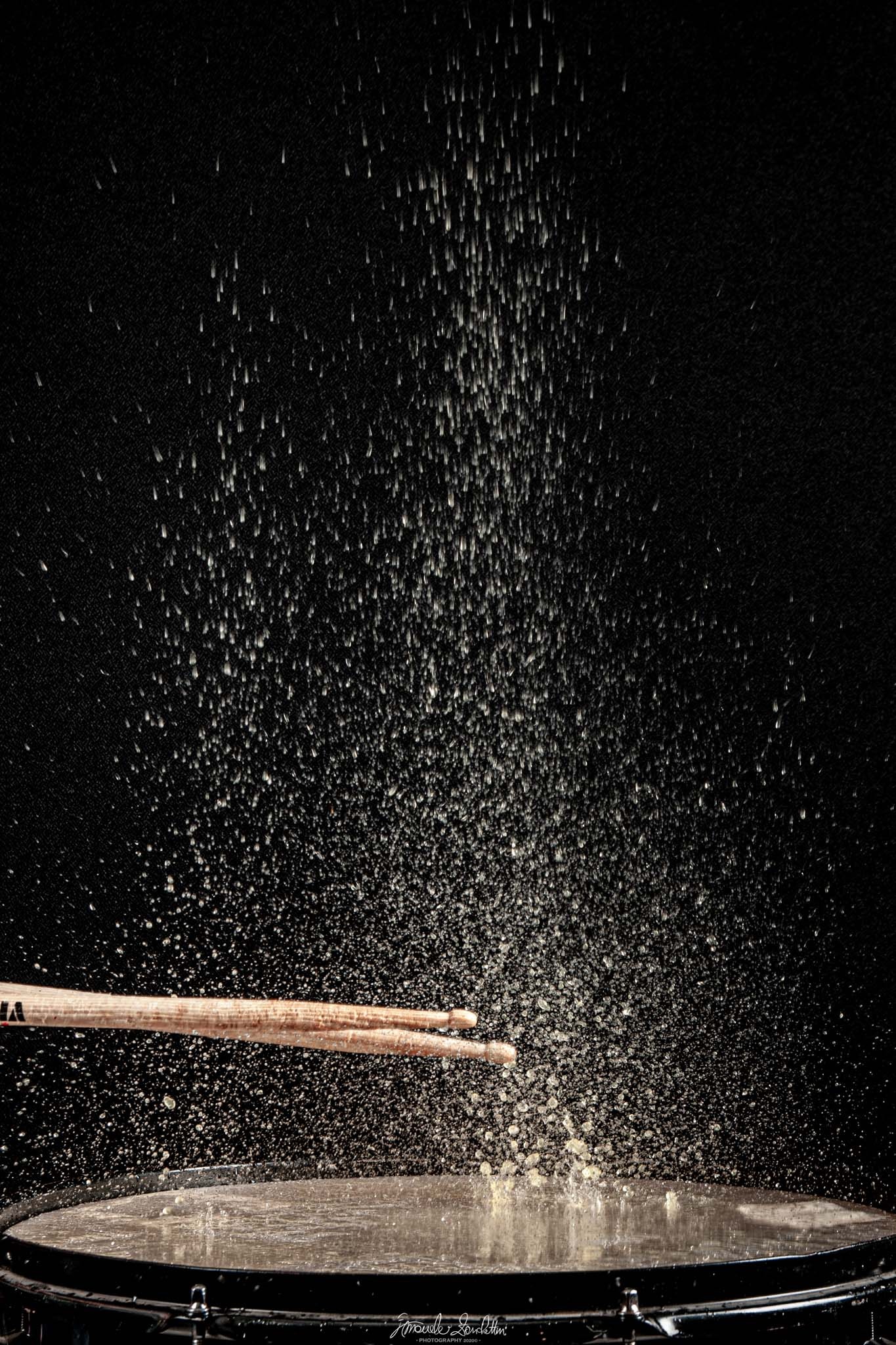
Water striking a drum skin lasts only a fraction of a second, but the photograph turns it into a pattern of separate drops. The sticks establish the action, the rim gives the explosion a base and the dark background makes each bright droplet easier to read.
The file records 1/160 second, f/11, ISO 100 and 50 mm. A shutter speed of 1/160 second alone would not normally freeze the quickest droplets under continuous light. The sharp particles against a dark setting are consistent with a brief flash pulse supplying most of the exposure: when that happens, the flash duration—not only the shutter setting—can become the effective time that freezes the action.
An experiment like this rarely produces the best arrangement immediately. Water quantity, the instant of impact, focus, flash direction and the position of the sticks all change the result. Keep the setup repeatable, inspect the frame and change only one element before trying again.
Let movement remain visible
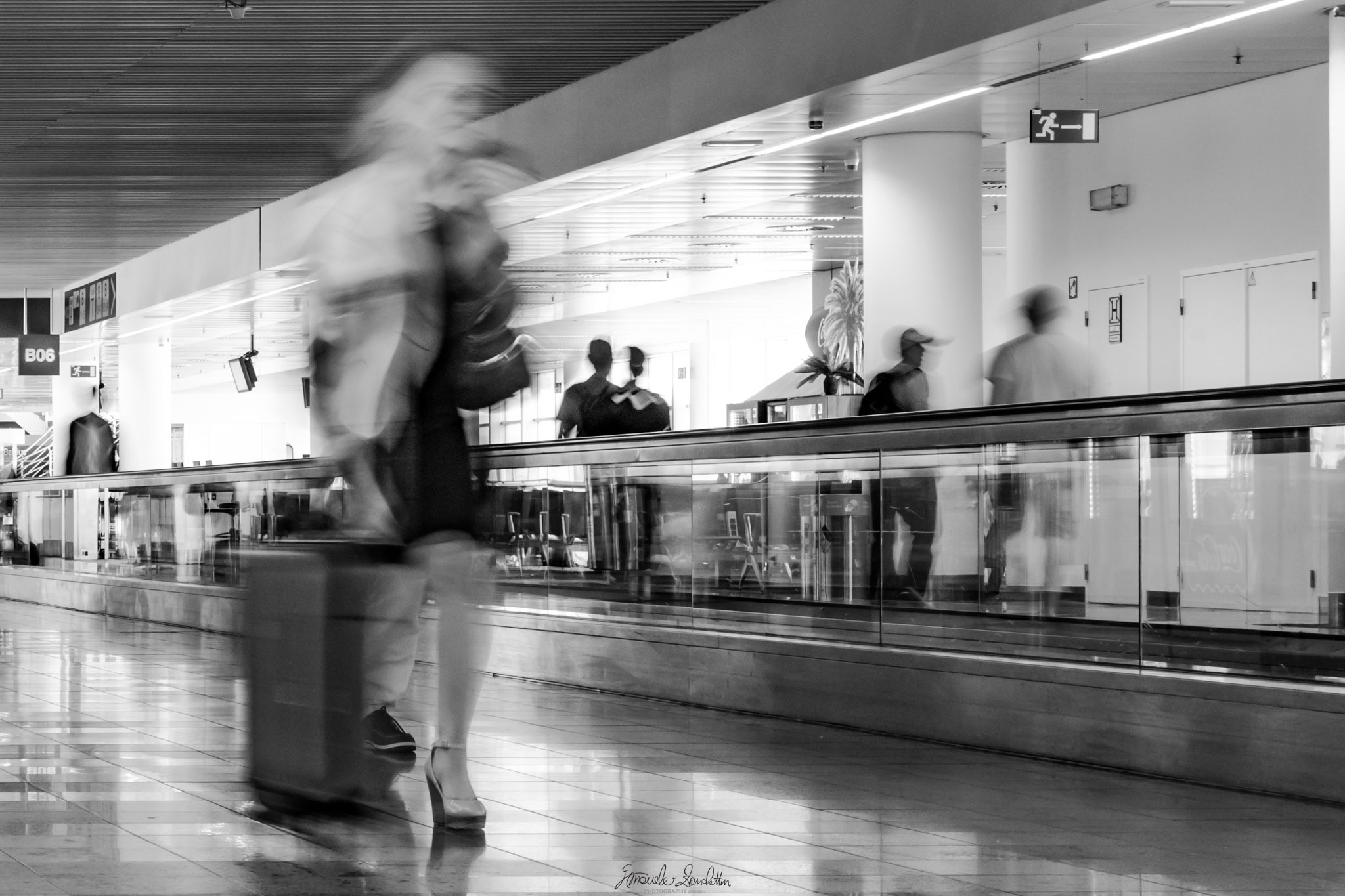
At an airport, the building stays still while travellers and the moving walkway continue through the exposure. The main figure becomes partly transparent and stretched, yet columns, signs and architectural lines remain recognisable. The contrast tells us more about the pace of the place than a completely frozen frame might.
This photograph records 1/2 second, f/16, ISO 200 and 50 mm. The small aperture helps control the light during the longer exposure, while a steady camera keeps the stationary structure defined. The amount of blur depends on how quickly the person moves, their direction and distance, and how long the shutter remains open.
For a first test, choose a safe place with a static background and regular movement. Support the camera and compare approximately 1/4 second, 1/2 second and one second. Do not ask which frame is technically perfect; ask which one keeps enough information about the subject while communicating motion most clearly.
Move the zoom during the exposure
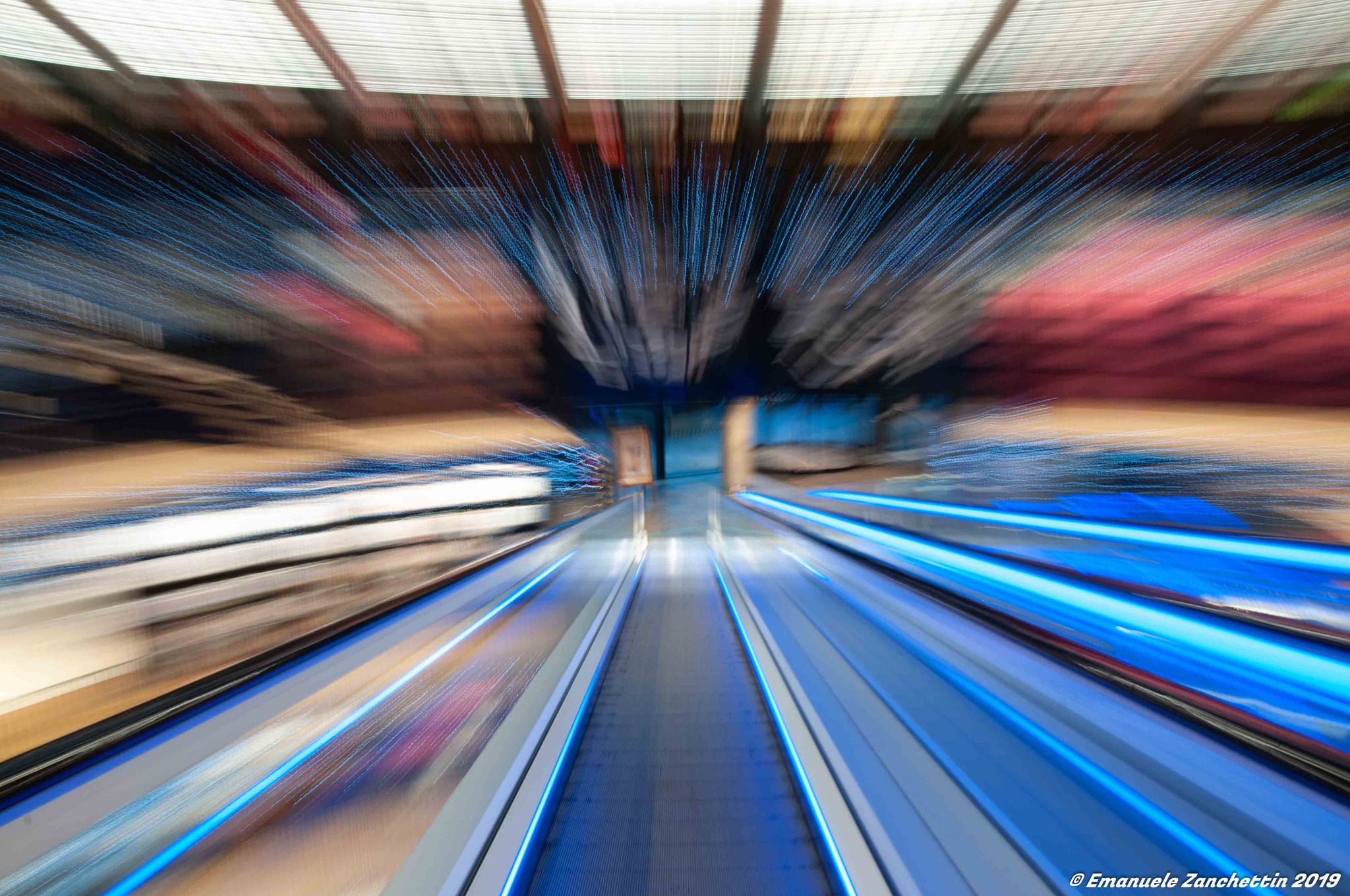
Changing the focal length while the shutter is open makes details travel across the sensor. Points and edges become lines that appear to rush towards or away from the optical centre. Repeated blue lights on the travelator make the effect especially clear because their paths draw the structure of the zoom movement.
The file records a 10-second exposure at f/14, ISO 100 and 18 mm. The low ISO and small aperture help make a long exposure possible. During those ten seconds, the speed, direction and smoothness of the zoom—and any pause before or after it—change how much of the original scene remains recognisable.
Place the visual centre deliberately before starting. Then make several versions: zoom in, zoom out, move quickly, move slowly, pause at one end or reverse direction. There is no single correct pattern. The useful question is whether the movement strengthens the subject or merely covers it.
Try, fail, change one thing and try again
An unsuccessful experiment is useful when you can identify why it failed. Was the blur too long, the frozen moment too early, the flash reflection distracting or the zoom centre misplaced? Keep the frame, choose one variable and make the next exposure with a specific change. That turns repetition into learning rather than random luck.
Sometimes the opportunity disappears before you can retry. The traveller has gone, the light has changed or the event will not happen twice. Record what you noticed anyway—settings, timing and the decision you would change. You may not get the same photograph again, but you can arrive at the next opportunity better prepared.
The aim is not to avoid failure. It is to become better at reading a result and deciding what the next frame needs.
Readers’ thoughts
Approved comments only · Shared across the English and Italian versions