
Seeing photographs
Finding visual humour in everyday photographs
A photograph can make us smile before we can explain why. Often the spark is a relationship: an object appears to look back at us, two shapes unexpectedly agree, or a familiar scene contains one surprising detail. The next task is to make that relationship readable.
The short version
- Look for relationships between objects, rather than an unusual subject alone.
- Keep enough surroundings to explain the surprise.
- Try small changes of position before changing your camera settings.
Notice what changes the ordinary
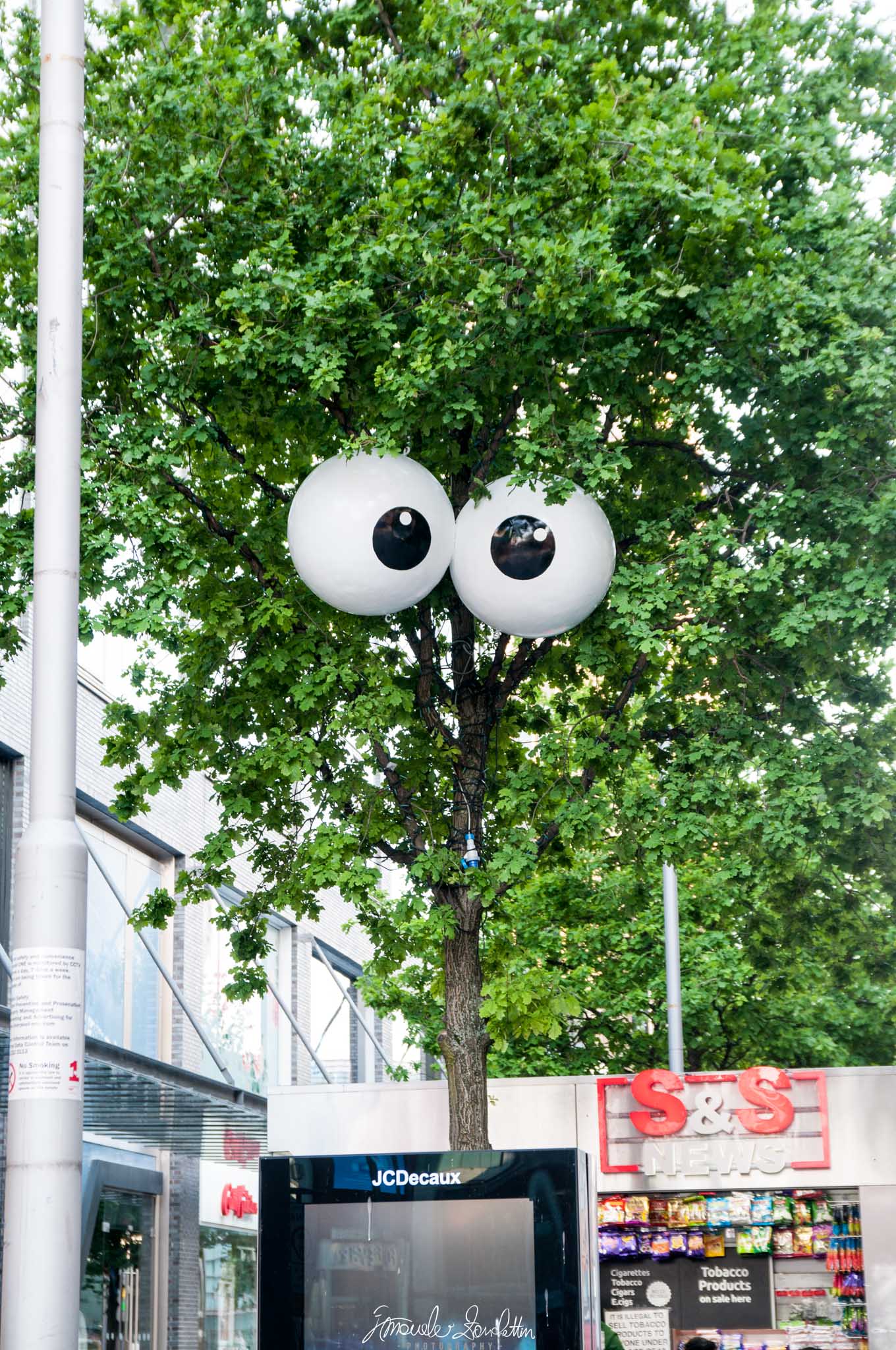
Start with something you already recognise. In this photograph, we can read the leaves as a tree and the shapes as eyes. Together they suggest a face. The humour depends on seeing both ideas at once; a close-up of only one white shape would offer much less to work with.
You do not need a spectacular location. Look for a reflection that completes a shape, a sign that seems to comment on its surroundings, or an object whose position suggests an unexpected action. Sometimes the relationship is there for a moment; sometimes you have walked past it repeatedly without noticing.
Move until the relationship becomes clear
Before taking several identical frames, move a little left or right. Raise or lower the camera. Watch the space around the important shapes and check whether a branch, sign or bright patch cuts across them. A small change in viewpoint can separate two elements that otherwise merge.
Keep your position safe and respect other people’s space. You can often make the idea clearer without getting closer: wait for an obstruction to pass, choose a simpler angle, or leave out a competing detail at the edge.
Decide how much of the setting to keep
Make a wider frame first. Then make a closer version. In the tree photograph, some ordinary surroundings help the unusual eyes feel unexpected. Remove everything except the eyes and the picture becomes a description of a decoration; include too much and the viewer may miss them.
Compare the two versions at a small size. What attracts you first? Can you still recognise the relationship without a caption explaining the joke? This is a useful test for a photograph that will be seen in a social feed.
Try a three-frame exercise
On your next short walk, choose one harmless visual surprise. Make three frames: one showing the setting, one concentrating on the relationship, and one from a different height or side. Keep the subject itself unchanged so that you can judge what your framing contributes.
Later, choose the frame that communicates with the least explanation. Write a plain sentence about what is actually visible, then see whether the photograph still works without it. Avoid making strangers the target of a joke or inventing a story about them. The strongest discovery may be a playful arrangement of ordinary things.
Readers’ thoughts
Approved comments only · Shared across the English and Italian versions